Under the Needle: How Kyushu Became the Unlikely Heartbeat of Japanese Tattoo Culture
Walk through the older neighborhoods of Fukuoka on a warm evening and you might notice something you wouldn't have seen even a decade ago — a young woman, sleeves rolled up, a sweeping wave pattern climbing her forearm, waiting in line at a ramen counter without a second glance from anyone around her. That image, small as it is, tells a bigger story about what's shifting in Kyushu right now.
Japan has one of the most complicated relationships with tattoo culture in the world. The association with organized crime — particularly the yakuza — baked a deep social stigma into the national consciousness that kept tattoos underground for most of the 20th century. Public bathhouses, gyms, and beaches still post signs banning inked visitors. Getting tattooed in Japan has long meant accepting a kind of quiet exile from certain corners of public life. But Kyushu, never quite content to follow the script handed down from Tokyo, has been quietly rewriting that story.
Why Kyushu? Why Now?
The timing isn't random, and neither is the location. Kyushu has always had a slightly different relationship with the outside world. For centuries, Nagasaki was Japan's only open port — the single crack in the country's self-imposed isolation — and that legacy of cultural exchange never fully faded. Kyushu absorbed foreign influence differently than the rest of the country. It processed it, argued with it, and eventually made it its own.
That same spirit is showing up in the tattoo studios now dotting Fukuoka, Kumamoto, and even smaller cities like Saga and Miyazaki. Artists here aren't just imitating what's happening in Tokyo or Osaka. They're pulling from something older and more local — the imagery of regional mythology, the geometric patterns found in ancient Yayoi-period artifacts unearthed across the island, the bold iconography of Kyushu's samurai clans, and the fishing and agricultural traditions that still pulse through the culture.
"I'm not interested in making something that looks like it came from a flash sheet," says Haruto, a Fukuoka-based artist who goes by his first name professionally and has a two-year waiting list that includes clients from New York, Berlin, and Sydney. "Every piece I do starts with a conversation about the person and the place. If they've never been to Kyushu, I want the design to make them feel like they have."
The Western Client Pipeline
Americans, in particular, have become a significant and growing part of the clientele for Kyushu's top tattoo artists. The reasons are layered. There's the obvious appeal of authenticity — getting a traditional Japanese design from an artist who is genuinely embedded in that cultural context feels different than getting one at a shop in Brooklyn, no matter how skilled the artist. But there's also the experience itself. Clients describe flying into Fukuoka, spending a few days eating their way through the city's legendary food scene, visiting temples and hot springs, and then sitting for a session that feels less like a transaction and more like a collaboration.
Maya, a graphic designer from Portland who flew to Fukuoka for a full sleeve consultation last spring, put it simply: "I wanted the design to mean something that I couldn't just Google. Haruto spent an hour asking me questions before he even picked up a pencil. That doesn't happen at home."
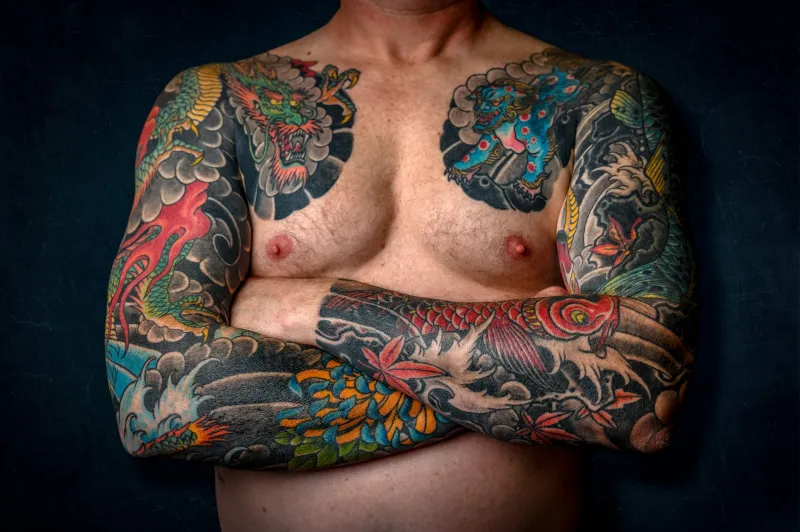
The designs these artists produce are rooted in irezumi — the traditional Japanese tattooing style with its characteristic bold outlines, dramatic shading, and thematic depth — but they're not frozen in time. Kyushu's artists are weaving in local specifics that make each piece genuinely unique. A phoenix rendered in the color palette of Hakata's famous Gion Yamakasa festival. A carp climbing a waterfall styled after the rivers of the Aso caldera region. Imagery drawn from the tanuki and kitsune folklore that saturates the island's rural shrines.
Breaking the Bathhouse Rule
The cultural shift happening around tattoos in Kyushu isn't just about aesthetics or tourism. It's a genuine generational renegotiation. Younger Japanese people — particularly in Kyushu's cities — are increasingly treating tattoos as personal expression rather than social declaration. The stigma hasn't vanished, but it's fraying at the edges in ways that would have seemed unthinkable twenty years ago.
Some Kyushu onsen operators have quietly begun updating their policies, designating private bath hours for tattooed guests or creating entirely tattoo-friendly facilities. It's a small shift, but a symbolic one. The bathhouse rule was always the most visible front line of tattoo discrimination in Japan, and the fact that it's softening — even incrementally — in a region known for its traditional hot spring culture says something real about the direction things are heading.
Artists like Keiko, who runs a studio in Kumamoto and specializes in incorporating Higo province imagery into contemporary minimalist designs, sees the change up close. "My grandmother would have been horrified by what I do for a living," she says with a laugh. "My mother pretended for years that I worked in graphic design. Now she shows my Instagram to her friends."
The Craft Underneath the Culture
It's worth being clear about something: the buzz around Kyushu's tattoo scene isn't just vibes and cultural cachet. The technical skill on display in these studios is genuinely world-class. Several Kyushu artists have placed at international tattoo conventions, and the work circulating on social media from this region has a visual coherence and depth that stands apart from a lot of what's trending globally.
Part of that comes from an unusual commitment to apprenticeship. Several of Kyushu's most prominent artists trained under older masters who maintained the traditional approach to learning the craft — years of observation, practice on synthetic skin, and gradual introduction to clients before ever working independently. That foundation shows in the finished work. The lines hold differently. The gradients have a quality that's hard to describe but immediately recognizable.
"You can feel in a tattoo whether the person who made it understood patience," Haruto says. "That's not something you can fake."
What Comes Next
Kyushu's tattoo scene is at an interesting inflection point. The international attention is real and growing, but so is the risk that comes with it — the possibility that what makes this corner of Japan's ink world special gets diluted by demand, imitation, or the flattening effect of global trend cycles.
The artists themselves seem aware of that tension. Most of them are deliberately keeping their practices small, their waiting lists long, and their designs deeply tied to the specific cultural geography of the island they call home. That's not just a business strategy. It's a statement about what they think this work is actually for.
For anyone planning a trip to Kyushu — and if you haven't, you should be — the tattoo scene is now as much a part of the cultural itinerary as the ramen, the ceramics, and the volcanic landscapes. It's not a novelty. It's a living art form finding its footing again after a long, complicated century, and Kyushu is where it's happening.