Green Gold and Gut Instinct: How Kyushu's Rebel Tea Farmers Are Rewriting the Rules of Japanese Tea
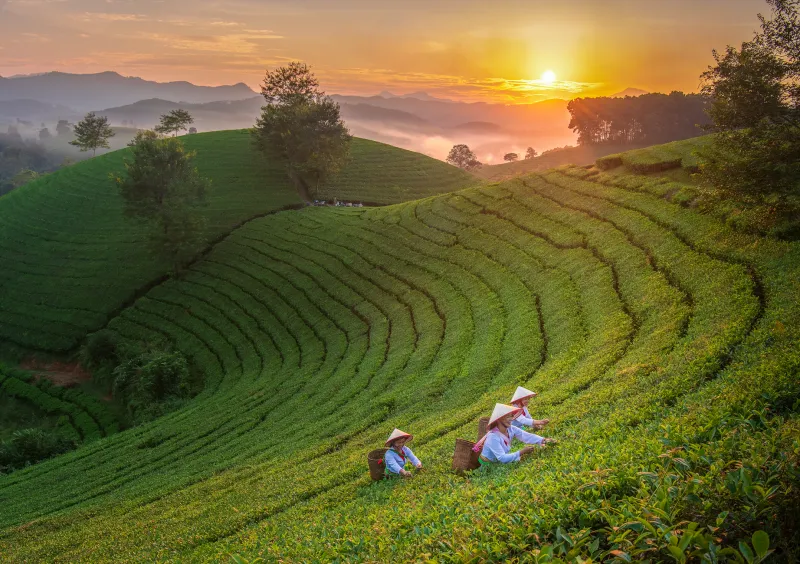
There's a version of Japanese tea that most Americans know — the ceremonial matcha stirred into a frothy bowl, the pale green sencha that arrives with sushi. Peaceful. Ancient. A little intimidating. And almost always associated with one place: Shizuoka, the prefectural giant that has dominated Japan's tea economy for centuries.
But something is quietly brewing in Kyushu, and it doesn't look — or taste — like anything that came before it.
The Island That Tea Forgot (And Then Remembered)
Kyushu has always grown tea. Ureshino, a small onsen town tucked into the hills of Saga Prefecture, has been producing leaves since the 1400s. Kagoshima, way down in the south, is actually Japan's second-largest tea-producing region by volume. But for most of modern history, Kyushu played a supporting role — supplying raw leaves that would get blended, branded, and sold under someone else's name, usually from somewhere further east.
That arrangement suited the industry fine. Until it didn't.
"We were invisible," says Haruka Nishimoto, 31, who returned to her family's small farm in Ureshino after five years working in food marketing in Fukuoka. "Our tea was going into bags that said 'Japanese green tea' with no indication of where it actually came from. I got tired of that."
Nishimoto is now one of a growing number of young Kyushu farmers who have opted out of the wholesale supply chain entirely, building direct-to-consumer brands that ship internationally — including, increasingly, to customers in the United States.
Fermentation: The Word That's Changing Everything
Walk into a conventional Japanese tea conversation and the F-word — fermentation — will raise eyebrows. Japanese green tea is prized precisely for its freshness, its grassy brightness, its careful avoidance of oxidation. The whole point is to stop the clock on the leaf the moment it's picked.
But a handful of Kyushu producers are deliberately hitting pause on that assumption.
Takeshi Yamada, 38, farms about four acres on the slopes above Chiran in Kagoshima, a town better known for its samurai gardens and its tragic World War II kamikaze history. Yamada has been experimenting for three years with a light-fermentation process inspired loosely by Chinese oolong and pu-erh traditions, adapted to Kyushu's specific leaf varieties and humidity levels.
"I'm not trying to make Chinese tea," he's quick to clarify. "I'm trying to find out what our leaves want to become if you give them a little more time."
What they become, it turns out, is something that tastes almost nothing like the sencha your Japanese grandmother might pour you. Yamada's current fermented release — which he sells under the label Chiran Amber — has notes that American reviewers have compared to toasted grain, dried apricot, and a whisper of smoke. It has developed a small but devoted following among specialty tea shops in Portland, Oregon and Brooklyn, New York, where consumers already fluent in the language of natural wine and artisan coffee have embraced it enthusiastically.
"It fits the way a lot of Americans are already drinking," says Yamada. "Curious. A little adventurous. Not afraid of complexity."
The Blending Experiment Nobody Expected to Work
In Nagasaki Prefecture, where Dutch and Chinese traders once made Kyushu a crossroads of global flavor, another kind of experimentation is underway. Keiko Fujishiro, 27, is blending Kyushu-grown green tea with locally sourced citrus peel, dried shiso leaf, and in one particularly bold release, a small percentage of roasted barley from a neighboring farm.
Blending isn't new in tea. But doing it transparently, with fully disclosed local sourcing and an emphasis on terroir — the way a wine producer might talk about soil and microclimate — is a relatively fresh concept in the Japanese market. Fujishiro learned the vocabulary, somewhat improbably, from following American specialty coffee culture online.
"I saw how baristas in the US were talking about where their beans came from, what elevation, what processing method," she says. "I thought — why don't we do that with tea? Why is it all just 'green tea'?"
Her brand, Dejima Blend, named after the famous artificial island where Nagasaki's international trade once concentrated, now ships to around 200 individual customers in the US each month through a subscription model. The margins are thin, she admits. The logistics are occasionally a nightmare. But the connection to her customers — who send her messages, ask questions, share photos — is something she says she couldn't get from selling wholesale.
Sustainability Isn't a Buzzword Here — It's Survival
One thread that runs through nearly every conversation with these young Kyushu tea farmers is a frankness about the environment that can feel almost startling compared to the careful language of larger agricultural industries.
Climate change is not an abstraction in the tea fields of southern Kyushu. Kagoshima's summers are hotter than they used to be. Rainfall patterns have shifted. Farmers who have grown the same varieties in the same ways for generations are finding that the old playbook doesn't always work anymore.
For some younger producers, this disruption has become an unexpected opening. If the old methods are under stress anyway, why not experiment? Why not try new varietals, new processing techniques, new business models?
Nishimoto has converted her family's fields to fully organic production — a difficult and expensive certification process in Japan — and is trialing two heirloom tea varietals that had largely fallen out of commercial use. "They're lower yield," she says matter-of-factly. "But the flavor is extraordinary. And they seem to handle the heat a little better. We're watching."
Yamada, similarly, has planted a test plot with a varietal more commonly found in Taiwan, curious whether Kagoshima's climate might produce something unexpected. "I'm not precious about it," he says. "The mountain doesn't care about tradition. Neither does the weather."
What the US Market Actually Wants
For all three farmers, the American customer has become something of a north star — demanding in the best way, willing to pay for quality and story, and refreshingly unburdened by the hierarchies that can make the Japanese domestic market feel rigid.
Specialty tea in the US is still a relatively young industry compared to coffee, but it's growing fast. Subscription boxes, direct-import boutiques, and a generation of tea drinkers who came up through the craft beverage scene have created an audience that's genuinely hungry for something new — something that can hold its own next to a natural wine or a single-origin espresso.
Kyushu's rebels are betting that their corner of Japan, long overlooked and quietly resilient, is exactly where that something new is coming from.
"People always ask me if I'm worried about competing with Shizuoka," Nishimoto says, laughing. "I'm not competing with Shizuoka. I'm doing something completely different. That's the whole point."
She's probably right. And if the early signals from Portland and Brooklyn are anything to go by, a lot of American tea drinkers are starting to agree.