She Left Her Corner Office for a 200-Year-Old Building Full of Books — and She'd Do It Again
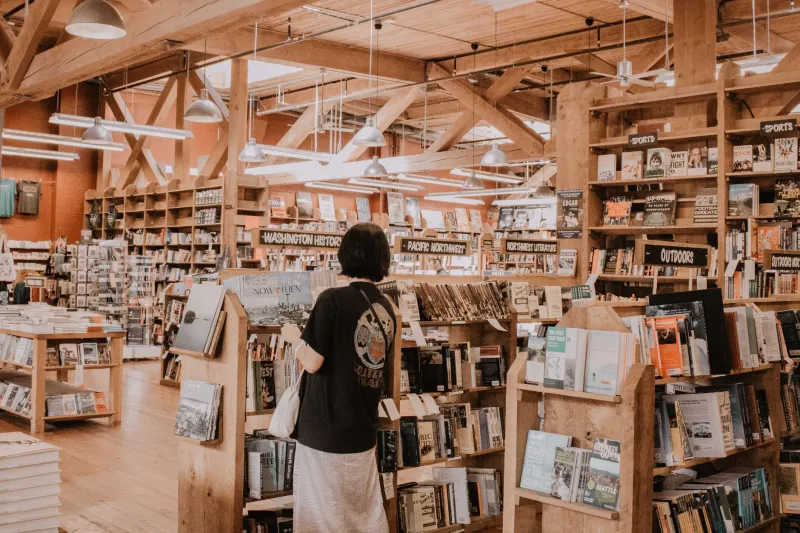
There's a particular kind of quiet that lives inside old Japanese buildings. Not the silence of emptiness, but the kind that feels occupied — by wood that's been breathing for two centuries, by the memory of people who cooked and bargained and slept under the same beams now overhead. Claire Beaumont noticed it the first time she stepped inside what would become her bookstore, a former merchant's house in Yame, a small city in Fukuoka Prefecture known mostly for its tea and its stubbornness about remaining exactly what it's always been.
"I walked in and thought, this is either the best idea I've ever had or the worst," she says, laughing from behind a low wooden counter stacked with new arrivals. "Turns out it's both."
Claire, originally from Portland, Oregon, spent eleven years working in financial services in Tokyo before a combination of burnout, curiosity, and what she describes as "a minor existential spiral" sent her looking for something different. She'd been visiting Kyushu on weekends for years, drawn to the region's slower tempo and its particular brand of pride — the kind that doesn't feel the need to announce itself. When the merchant house came up for lease, she signed the papers before she'd written a business plan.
A Building That Comes With Its Own Opinions
The structure dates to the early 1800s. Its owner, a local preservation-minded family, had been watching it deteriorate for years and wanted someone who would actually use it — not turn it into a weekend rental or gut it for a café aesthetic. Claire qualified on both counts. She wanted to use it, and she had no intention of gutting anything.
But working with a 200-year-old building is, she'll tell you plainly, "like having a very opinionated business partner who communicates exclusively through water damage and mysterious drafts." The first year involved as much structural problem-solving as it did bookselling. Certain walls couldn't be touched. Certain floors couldn't bear modern shelving without reinforcement. The building had opinions about lighting fixtures, about where foot traffic should flow, about which rooms felt right for which moods.
She leaned into it. The front room, with its high ceilings and paper-screened windows, became the main floor — Japanese literature, regional history, and a small but carefully chosen English-language section aimed at travelers and expats. A narrower back room, darker and more intimate, became what regulars now call "the cave" — used books, poetry, philosophy, and a reading nook with floor cushions where people sometimes sit for an hour without buying anything. Claire doesn't mind.
Curating for Two Very Different Readers
Running a bilingual bookstore in a rural Japanese city means serving two audiences that rarely overlap and want almost completely different things. Local customers — many of them older, deeply rooted in the region — tend to come for specific authors, for books about Kyushu's history and folklore, or simply because the building itself is a piece of their own memory. Some remember when it was still an active merchant's house. A few remember the family that ran it.
Tourists and expats, by contrast, often want what they can't easily find elsewhere: English-language books about Japan that go beyond the tourist-shelf basics, translated Kyushu authors, or just the experience of being somewhere that feels genuinely lived-in rather than staged.
Claire threads this needle carefully. She attends book fairs in Fukuoka and Osaka. She's built relationships with small publishers who specialize in regional Japanese literature. She stocks zines from local artists alongside first editions from Tokyo dealers. The English section is curated with the kind of specificity that signals to browsing travelers: someone who actually reads made these choices.
"I don't want it to feel like an airport bookstore that happens to be in a pretty building," she says. "I want people to find something they didn't know they were looking for."
The Financial Reality Nobody Romanticizes
Here's where the story gets less Instagram-ready. Independent bookstores are hard. Independent bookstores in rural Japan are harder. Independent bookstores in rural Japan run by a foreign woman in a building that requires ongoing preservation costs are, by most conventional measures, a financial adventure.
Claire is honest about this in a way that feels refreshing rather than discouraging. She supplements book sales with a small events program — author readings, translation workshops, a monthly gathering she calls "Slow Sundays" where people bring something to read and sit together in companionable silence. She rents the back room for small meetings and the occasional photography shoot. A modest online shop ships to customers in the US, Australia, and the UK who discovered her through word of mouth and social media.
She's not getting rich. She's also not going back to Tokyo.
"People ask me all the time if I'm worried about the business," she says. "And I am, sometimes. But I'm more worried about what happens to places like this if nobody tries. The building was going to keep sitting empty. The neighborhood was going to keep losing things."
Why Physical Books Still Matter — Especially Here
There's a broader argument embedded in what Claire is doing, even if she makes it quietly. The conversation about the death of physical books has been happening in the US for twenty years and still hasn't resolved itself — bookstores keep closing and new ones keep opening, and readers keep showing up in ways that confound the predictions.
In Japan, the dynamic is slightly different. Bookstore closures have accelerated across rural areas as populations age and younger residents migrate to cities. The loss isn't just commercial — it's cultural. A town without a bookstore is a town that has lost one of its gathering points, one of its arguments for staying.
Claire's shop, improbably housed in a building that predates the American Civil War, is making that argument in Yame. On a recent Saturday afternoon, a grandmother and her teenage granddaughter were browsing the folklore section together. A man in his fifties was reading in the cave. Two tourists from California were photographing the courtyard and asking Claire for restaurant recommendations.
None of them had anywhere better to be.
"I think people are hungry for places that aren't optimized," Claire says. "This building isn't optimized. The shelves aren't optimized. The whole thing is kind of a mess, honestly. And people love it for exactly that reason."
She pauses, straightening a stack of new arrivals that immediately tilts back to its original angle.
"The building's been here two hundred years," she adds. "It'll probably outlast all of us. I'm just the person who decided to fill it with books for a while."