Ink Without Shame: Kyushu's Tattoo Artists Are Rewriting the Rules of Japanese Body Art
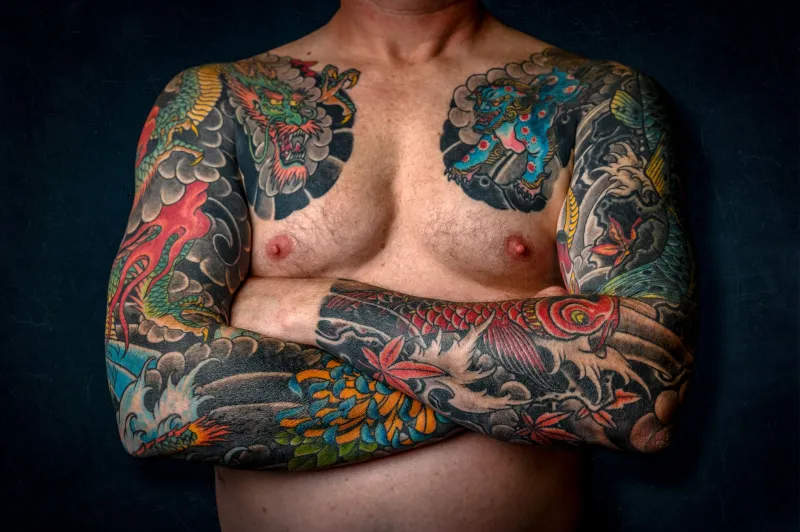
Walk into Hana Morimoto's studio in Fukuoka's Daimyo neighborhood and the first thing you notice is the light. It floods in through floor-to-ceiling windows, bouncing off framed prints of chrysanthemums, koi, and waves rendered in traditional irezumi style. There's a playlist humming softly in the background — some kind of lo-fi jazz. The whole setup looks less like what most Americans picture when they hear "Japanese tattoo" and a lot more like a gallery in Brooklyn.
That's intentional.
"I want people to feel like they're coming to see an artist," Morimoto says, setting down her tattoo machine to talk. "Not a criminal. Not a gangster. An artist."
She's 31, soft-spoken, and covered in her own work — delicate temple dogs crawling up her forearms, a phoenix mid-flight across her collarbone. She's also fully booked through next year, with a waiting list that stretches across three continents.
The Weight of the Stereotype
To understand why what Morimoto and her peers are doing matters, you need a little context. Japanese tattoos — irezumi — have roots going back centuries. Historically, they served ceremonial purposes, marked social status, and functioned as spiritual protection. But somewhere along the way, they became almost exclusively associated with the yakuza, Japan's organized crime syndicates, who adopted elaborate full-body tattoos as a badge of loyalty and toughness.
That association didn't stay inside Japan. It traveled globally, and it stuck. Even today, tattooed customers get turned away from Japanese hot springs, gyms, and public pools. Some employers still won't hire visibly tattooed workers. For decades, being a tattoo artist in Japan meant operating in a legal gray zone — the practice technically required a medical license under a 1948 law that wasn't seriously enforced until recent years, when authorities started cracking down.
In 2020, Japan's Supreme Court finally ruled that tattooing doesn't constitute a medical procedure, a decision that sent ripples through the industry. It didn't erase the stigma overnight. But it opened a door.
A New Generation Steps Through
Kyushu, with its historically outward-facing culture — this is the island that served as Japan's gateway to the outside world for centuries — has become an unlikely epicenter for the tattoo renaissance. Artists here seem particularly energized by the moment.
Takeshi Ueda operates out of a converted machiya townhouse in Nagasaki. He trained under a traditional tebori master — the hand-poked technique that produces a softer, more diffused line than machine work — but he's not precious about it. His Instagram feed blends centuries-old motifs with contemporary color theory, and his clients include a film director from Seoul, a musician from Berlin, and a retired firefighter from Phoenix who flew over specifically for a sleeve.
"The foreigners understood before Japanese people did," Ueda says with a laugh that's equal parts rueful and proud. "They saw the art first. They didn't see the baggage."
That international appetite has been transformative. Artists who once struggled to find domestic clients willing to be seen getting tattooed are now navigating complex waitlists, with many of their bookings coming from the US and Europe. The tattoo tourism angle — flying to Japan specifically to get inked by a master — has been quietly booming for years, but the Kyushu scene has only recently started getting its share of the attention.
Philosophy Over Flash
What distinguishes the best of Kyushu's new-wave tattooists isn't just technical skill — it's the philosophical framework they bring to the work.
Morimoto spends the first consultation almost entirely in conversation, asking about a client's family history, their relationship with nature, what images they've returned to throughout their life. A tattoo, in her view, is a collaboration between the artist, the client, and the cultural lineage that produced the motifs in the first place.
"Every dragon I draw is connected to every dragon that came before it," she explains. "I'm not inventing anything. I'm continuing something. That's a responsibility."
Ueda frames it differently but arrives at a similar place. He talks about ma — the Japanese concept of negative space, of meaningful emptiness — and how it applies to body art. A tattoo that covers everything says nothing, he argues. Restraint is its own kind of power.
This kind of thoughtfulness is resonating. International tattoo conventions, from London to Miami, have started featuring Kyushu artists prominently. Awards that once went almost exclusively to American and European artists are now regularly going to Japanese practitioners, with several from Kyushu taking top honors in traditional categories.
The Older Guard and the New Conversation
It would be easy to frame this as a clean generational break — young artists heroically separating themselves from a dark legacy. But the reality is messier and more interesting than that.
Some of the most respected voices in the conversation are older artists who themselves have complicated histories. One master in Kitakyushu, who asked not to be named, spent years tattooing yakuza members because they were the only clients who would come. He doesn't apologize for it. He also doesn't romanticize it.
"They were customers," he says simply. "Now I have different customers. The craft doesn't change."
Younger artists tend to be more vocal about wanting distance from that chapter of the industry's history, but they also acknowledge the technical knowledge that flowed through those networks. Traditional tattooing survived in Japan partly because the yakuza kept commissioning it. That's a complicated legacy to sit with.
What It Looks Like Going Forward
Back in Fukuoka, Morimoto is preparing for a client session — a woman from Chicago who's been corresponding with her for eight months, designing a piece that incorporates her Japanese grandmother's home prefecture's traditional textile patterns alongside classic irezumi imagery.
The piece will take three sessions over the course of a week. The client has already booked her flights.
This is what the future of Japanese tattoo culture might look like: deeply personal, globally connected, rooted in history without being trapped by it. Artists like Morimoto and Ueda aren't trying to erase the past. They're insisting that the past is bigger — and richer — than any single association.
"People come here expecting something dark and mysterious," Morimoto says, smiling as she pulls on her gloves. "I want to give them something beautiful instead. Something that lasts."
In Kyushu, at least, the needle is moving in the right direction.