Smell Like Kyushu: The Tiny Perfume Ateliers Bottling a Region's Soul
There's a bottle sitting on a shelf in a fragrance boutique in Brooklyn that smells, according to its hand-lettered label, like "the moss at the base of a torii gate after rain." It was made in a converted farmhouse outside Saga City by a woman who used to work in pharmaceutical research. It sold out in four days.
This is what's quietly happening in Kyushu right now — and most people, even in Japan, have no idea.
More Than a Scent, It's a Place
The fragrance industry has long chased the exotic. Oud from the Middle East, neroli from the Mediterranean coast, vetiver from Haiti. But a handful of independent perfumers scattered across Kyushu's seven prefectures are making a compelling case that this southwestern corner of Japan has been sitting on an olfactory goldmine for centuries.
Think yuzu peel harvested from the terraced groves of Oita. Camphor wood shaved from trees that shade Shinto shrines in Miyazaki. Wild chrysanthemum gathered near the volcanic ridgelines of Aso. These aren't just pretty ingredients — they're hyperlocal in a way that defies mass production. You can't just order them through a distributor. You have to know where to look, and more importantly, you have to know who to ask.
"Most of my materials come from relationships, not suppliers," says Mitsuki Harada, the former pharmaceutical researcher now running a one-woman atelier called Kiri Kobo (roughly, "Mist Workshop") outside Saga. "A farmer I've known since childhood saves me dried citrus rind. A shrine caretaker lets me collect fallen hinoki cypress bark. It takes years to build that kind of trust."
Her current collection includes a scent she describes as an homage to the Nabeshima clan — the feudal lords who once ruled the region — built around aged cedar, iron-mineral water, and a base note she refuses to fully disclose. It retails for $240 a bottle on a Parisian niche fragrance platform. She makes around 80 bottles per batch.
The Ritual Connection
What separates Kyushu's emerging perfume scene from, say, a craft candle maker in Portland isn't just the ingredients — it's the conceptual depth. Several of these artisans are drawing directly from Shinto traditions that predate written Japanese history, translating ritual into scent in ways that feel genuinely spiritual rather than gimmicky.
Takeru Nishida, who operates out of a narrow studio in Kagoshima's old merchant quarter, spent three years researching the misogi purification ritual — a Shinto practice involving water, salt, and sacred plants — before releasing his debut collection. Each of his five fragrances corresponds to a different stage of the ceremony.
"In the West, perfume is often about attraction or status," Nishida explains. "In the Shinto framework I'm working from, scent is about cleansing and connection to the kami. That's a completely different intention, and I think people feel it when they wear it."
His collection, Harae, is now stocked by a single boutique in Los Angeles's Silver Lake neighborhood, where it reportedly sells briskly to customers who describe themselves as interested in "intentional living." The cultural gap between a Kagoshima shrine forest and a Silver Lake apartment is enormous — and somehow, that gap seems to be exactly where the appeal lives.
Enter the Expats
It wouldn't be a Kyushu creative story without the expats. Just as the region has drawn foreign brewers, potters, and filmmakers in recent years, its fragrance scene is attracting a particular breed of creative transplant: people trained in perfumery elsewhere who came to Kyushu for a residency or a relationship and simply never left.
Amélie Renard, a Lyonnaise perfumer who trained under a Grasse-based master, moved to Fukuoka six years ago with her Japanese partner and ended up apprenticing informally with a Munakata shrine botanist. Her line, Tsuchi ("Earth"), fuses classical French construction with ingredients she sources entirely from northern Fukuoka Prefecture.
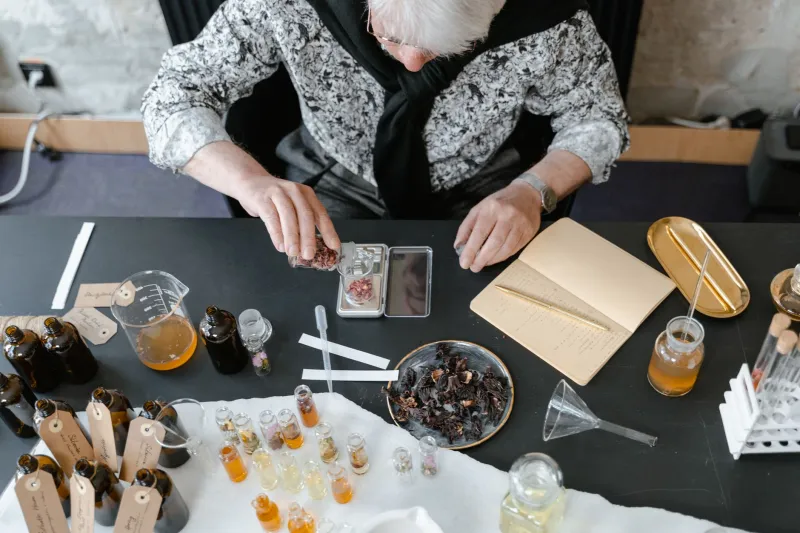
"French perfumery has incredible technical tradition," she says, arranging tiny brown bottles on a low table in her Hakata apartment-turned-studio. "But Kyushu has ingredients and reference points that French perfumery has never touched. It's like having access to a library no one else has read."
Her bestseller is a fragrance built around igusa — the rush grass used to make tatami mats — layered with yuzu and white sandalwood. She describes it as "the smell of a Japanese room on a summer morning." A fragrance reviewer for a major US lifestyle publication called it "the most transportive thing I've smelled in a decade."
Small Batches, Big Attention
The commercial reality of this scene is genuinely unusual. None of these perfumers are getting rich. Batch sizes are tiny, ingredients are painstaking to source, and the marketing is almost entirely word-of-mouth or driven by fragrance enthusiast communities online — the kind of deeply nerdy forums where people argue for hours about drydown notes and projection.
But within those communities, Kyushu is becoming a name that carries weight. The hashtag #KyushuFragrance has a small but devoted following on fragrance-focused corners of social media, and at least two major niche fragrance retailers in New York and Los Angeles have begun actively seeking out Japanese indie perfumers to carry.
Harada of Kiri Kobo got her first international stockist after a fragrance blogger from Austin, Texas posted a lengthy review of her Nabeshima collection. "I didn't even know he had bought it," she laughs. "He must have found me through someone else."
Why Kyushu?
It's worth asking why this is happening here specifically, rather than in Kyoto or Hokkaido or some other region equally rich in botanical and cultural history.
Part of the answer is practical: land is affordable, the climate is mild enough to grow a diverse range of plants, and the region's agricultural networks are intact in ways that more urbanized parts of Japan aren't. But the deeper answer might be cultural. Kyushu has always had a slightly independent streak — geographically and historically closer to Korea and China than to Tokyo, with a tradition of absorbing outside influences and remaking them into something distinctly its own.
That same openness seems to be drawing creative people who want to work outside the established frameworks of their industries. And perfume, of all things, might be the ideal medium for that impulse. It's intimate, it's sensory, it carries memory in a way nothing else quite does.
A bottle that smells like the moss at the base of a torii gate after rain isn't just a product. It's an argument that a place matters — that it has a smell, a soul, a story worth paying attention to.
Kyushu has been making that argument for a long time. It's just that now, people are finally starting to inhale.