Off the Beaten Path and Into the Sacred: What Western Visitors Actually Find on Kyushu's Forgotten Pilgrimage Routes
Dave Kowalski, a 41-year-old physical therapist from Columbus, Ohio, did not plan to spend four days walking between mountain shrines in Oita Prefecture. He'd booked a week in Japan with vague intentions — some city stuff, maybe a day trip or two — and ended up at a ryokan in Beppu whose owner, in broken but enthusiastic English, handed him a hand-drawn map and said something like, "You should walk this."
He walked it. He got lost twice. He sat for an hour at a hillside shrine where a caretaker brought him tea without being asked. He cried, briefly, at a waterfall that doesn't appear in any guidebook he's found since. "I've been to therapy," he says. "I've done meditation apps. Nothing has come close to whatever happened out there."
Dave is not an outlier anymore. He's the leading edge of something.
The Routes That Shikoku Gets Credit For
Most Western travelers who know anything about Japanese pilgrimage know about Shikoku's 88-temple circuit — the Ohenro route associated with the Buddhist monk Kukai, who is better known by his posthumous name Kobo Daishi. It's been covered in travel magazines, documented in memoirs, and has developed enough infrastructure for foreign walkers that it functions almost like a well-worn trail system.
Kyushu has its own pilgrimage networks, and they are considerably less discovered. The island's sacred geography is dense — Kyushu was a major center of early Japanese Buddhism and Shintoism, and centuries of religious activity have left a landscape threaded with routes connecting temples, mountain shrines, hot spring sanctuaries, and sites tied to folklore that predates written Japanese history.
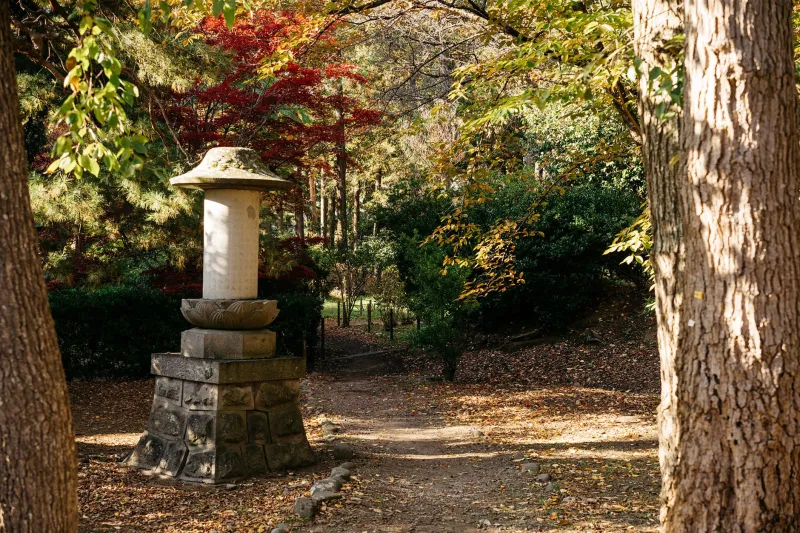
The Kyushu Olle routes, developed in partnership with South Korea's Jeju Olle trail system, have brought some international attention to the region's walking culture. But the older, less-branded pilgrimage paths — the ones local priests still walk, the ones marked by stone lanterns worn smooth by weather and time — remain largely invisible to outside visitors.
What Brings People Here
The Americans and Europeans showing up on Kyushu's sacred routes don't fit a single profile. There are the wellness seekers, post-pandemic and burned out, looking for something that a resort can't provide. There are the Buddhist practitioners who have read enough to know that Kyushu's temples hold history that Kyoto's more famous sites have partially traded for tourism revenue. There are the hikers who want trails without crowds. And there are the accidental pilgrims — people like Dave — who stumble into something they didn't know they were looking for.
What they share, broadly, is a preference for depth over efficiency. They're not trying to check boxes. They want to slow down in a way that feels earned rather than scheduled.
"I had done Kyoto and Nara," says Jennifer Marsh, a graphic designer from Portland who walked a section of the pilgrimage route connecting temples in Nagasaki Prefecture last spring. "They're beautiful. But I felt like a visitor the whole time. In Nagasaki, on this trail that nobody else was on, I felt like I was inside something rather than looking at it."
The Tension at the Temple Gate
Not every encounter between Western pilgrims and Kyushu's sacred sites goes smoothly, and it would be dishonest to pretend otherwise.
Some of the tension is logistical. Many of Kyushu's smaller temples and shrines have no English signage, no multilingual staff, and no infrastructure for visitors who arrive with different cultural assumptions about what a sacred site is for. A few priests interviewed for this piece described incidents — not malicious, just uninformed — where foreign visitors treated shrine grounds like photo sets, or asked to enter spaces that are not open to the public, or misread the ritual protocols around offerings and purification.
"We want people to come," says the head priest of a small mountain temple in Kumamoto Prefecture, speaking through a translator. "But we want them to come as guests, not as tourists. There is a difference. Most people understand this once someone explains it. The problem is that nobody explains it."
That gap — between the spiritual depth visitors are seeking and the cultural literacy required to access it respectfully — is the central challenge for Kyushu's pilgrimage communities as international interest grows.
The Communities Adapting (and the Ones That Aren't)
Some local communities are meeting this moment thoughtfully. A small network of temple lodgings — shukubo — in northern Kyushu has begun offering orientation sessions for foreign guests, delivered by English-speaking volunteers who walk visitors through basic protocols and, perhaps more importantly, the spirit behind them. The sessions aren't lectures. They're conversations.
In other places, the adaptation has been clumsier. A few sites have installed English signage that is technically accurate but tonally wrong — the kind of language that turns sacred instruction into theme park copy. One temple in Fukuoka Prefecture added a gift shop that sells shrine-adjacent merchandise in a way that local practitioners describe, with visible discomfort, as "not quite right."
The economics are real. Many of Kyushu's smaller religious sites operate on thin margins, maintained by aging caretakers and shrinking congregations. Tourism revenue isn't a luxury — for some, it's the difference between preservation and abandonment. The question of how much to adapt, and what gets lost in the adapting, is one that communities are working through in real time, without a clean answer.
What People Carry Home
Back in Columbus, Dave Kowalski has a small wooden stamp card — a nokyo-cho, the kind pilgrims collect ink stamps from temples along a route — that sits on his desk. He didn't finish the route. He didn't collect enough stamps to matter by any formal measure. But he keeps it where he can see it.
"It's not a souvenir," he says. "I don't totally know what it is. Something happened on that walk that I'm still processing. I think that's probably the point."
That unresolved quality — the way Kyushu's pilgrimage routes resist being neatly packaged into a takeaway — might be their greatest protection against the kind of tourism that hollows places out. Some experiences don't scale. Some things only work if you're willing to be a little lost.
Kyushu has plenty of those. The trick is getting there before someone puts up a sign.