They Had the Corner Office. They Chose the Tea Field Instead.
Matt Greer spent eleven years in financial consulting in Chicago. He wore the suits, hit the quarterly targets, and did what you're supposed to do when you're good at numbers and ambitious enough to act on it. Then he flew to Kagoshima on a two-week vacation in 2018, stood at the edge of a tea field in the Chiran highlands at 6 a.m., and something in him just — stopped.
"I kept waiting for the feeling to pass," he says, laughing a little. "It didn't."
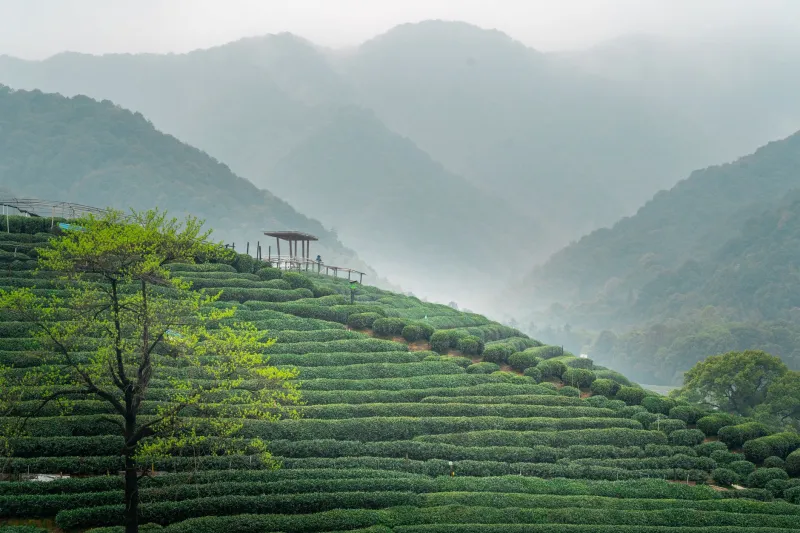
He moved to Kyushu the following year. He now tends about two acres of single-origin green tea on a hillside that looks like it was painted by someone who had way too much time and talent. He is not alone.
Why Kyushu, of All Places
Kagoshima Prefecture is Japan's second-largest tea-producing region, trailing only Shizuoka. But while Shizuoka gets most of the global press, Kyushu's tea culture has its own distinct personality — older in some ways, more experimental in others, and increasingly drawing the attention of specialty buyers from the US, Europe, and Australia.
The region's volcanic soil, dramatic elevation shifts, and clean mountain water create what growers call exceptional terroir — a French word that tea people borrowed from wine people, and that basically means the land itself has flavor. Kyushu's version of that flavor leans umami-rich and complex, with a grassy sweetness that high-end tea buyers have started paying serious attention to.
For a certain kind of American — burned out, curious, and willing to blow up their resume — it turns out this is a deeply compelling combination.
Sarah Kowalczyk, a former UX designer from Seattle, puts it plainly: "I knew nothing about tea farming when I got here. I knew I needed to be outside, I needed to work with my hands, and I needed to stop staring at a screen for twelve hours a day. Kyushu checked every box."
She's been here four years now. Her small operation in the mountains above Yame, in Fukuoka Prefecture, produces a limited run of gyokuro — a shade-grown green tea that's among the most labor-intensive and prized varieties in Japan. She sells most of it directly to tea shops in Portland, Austin, and New York.
Learning to Slow Down Without Stopping Entirely
Becoming a tea farmer in Japan as a foreigner is not a romantic weekend project. It requires navigating agricultural licensing, building trust with deeply traditional local communities, learning a language that doesn't really have a casual gear, and accepting that your first harvest probably won't be very good.
"The older farmers here were polite but skeptical," admits Daniel Park, a Korean-American from Los Angeles who left a marketing director role to apprentice under a third-generation tea grower in Ureshino, Saga Prefecture. "I don't blame them. Why would you trust some guy from California with knowledge that took your family a hundred years to develop?"
Park spent three years working essentially as a farmhand before he was trusted with any real decision-making. He describes it as the most humbling and clarifying experience of his adult life. "In LA, I was used to being the smartest person in the room, or at least acting like it. Here, I was the least qualified person on the property for a very long time. That's actually a good thing to experience."
Now, he co-manages the farm's production calendar and handles all of its English-language marketing — a role that didn't exist before he showed up and that the farm's owner, Hiroshi Tanaka, admits has changed the business in ways he didn't anticipate.
Where Outside Perspectives Are Actually Helping
This is the part of the story that tends to surprise people: these expats aren't just spiritual seekers finding themselves in the mountains. Many of them are bringing genuine professional skills that traditional tea communities are genuinely using.
Kowalczyk redesigned the entire e-commerce experience for the cooperative she works with in Yame, helping three small farms consolidate their online presence and start shipping directly to American consumers. Revenue from US sales has roughly doubled in two years.
Greer, the former financial consultant, helped the family he apprenticed under in Chiran restructure their pricing model for export. "They were undervaluing their product significantly," he says. "Not because they didn't know it was good — they knew. But the specialty tea market in the US operates differently than the domestic market here. There was a translation gap, and I happened to speak both languages."
Local agricultural cooperatives have started quietly noticing this pattern. A few have begun reaching out to foreign residents living in Kyushu — not to recruit them as farmers necessarily, but to explore whether their networks and market knowledge might help open new international channels.
The Thing Nobody Tells You About Farming
Ask any of these expats what they got wrong about their expectations, and the answers are remarkably consistent: they underestimated how physical it is, how seasonal it is, and how much of the work is waiting.
Tea harvesting in Kyushu happens in concentrated bursts — primarily in spring and early summer — and the rest of the year is maintenance, soil management, and preparation. For people trained to optimize every hour of their day, the rhythm takes serious adjustment.
"There's a Japanese concept called ma — negative space, the pause between things," says Park. "I spent my whole career trying to eliminate ma. Now I think it might be the whole point."
Greer is more pragmatic about it. "I still work hard. Probably harder, physically, than I ever did in consulting. But I go to bed tired in a different way. A better way."
None of them describe their former careers with bitterness. That's worth noting. This isn't a story about escaping something toxic — it's about choosing something that fits differently, at a different point in life.
What Comes Next
The specialty tea movement in the US has been growing steadily for years, driven by the same consumer forces that elevated craft coffee and small-batch spirits — a hunger for provenance, process, and products with a story behind them. Kyushu tea, with its distinctive regional character and centuries of craft tradition, is well-positioned to ride that wave.
Having a handful of English-speaking Americans embedded in those farming communities — people who understand both the product and the market — is an unexpected asset that nobody really planned for.
Kowalczyk is already training two new apprentices, one from Canada and one from the UK. She's not running a program. She's just doing what was done for her: making room for someone else who showed up and meant it.
"Kyushu has this way of holding onto people," she says, looking out over the terraced fields behind her farmhouse. "Once it gets into you, that's kind of it."
Somewhere down the mountain, a morning mist is rolling in off the valley. The tea doesn't care what your old job title was. It just needs tending.